-
Casa Triângulo is pleased to present Jardim Flamejante, Rafael Chavez's first solo exhibition at the gallery, with a critical essay by Walter Arcela. Photos: Filipe Berndt
-
-
Five Flaming Points of a Star
Point I – Heat as a ConditionIn the searing noontime heat of Paraíba’s arid caatinga, four young people try to shield themselves from the sun beneath a leafless umbuzeiro tree. To create shade, they tie a sheet to its bare branches. The improvised shelter offers little relief, as the caatinga’s hot breath, rising from the sparse, thorny growth all around, presses in on them. It is in this environment that Rafael Chavez, alongside artists Yasmin Formiga, Água Yayu, and her sister Rafaella Marinho, begin firing ceramics in a handmade kiln built in the middle of the caatinga. The firing starts at midday so that by late afternoon, around six o’clock, the clay reaches the point at which the material hardens and acquires a sheen.The kiln took four days to cool, and throughout those four days the mystery of whether the method would work hovered over Chavez’s anxious waiting. Ambient temperatures fluctuate between 35 and 38 degrees Celsius, which is nothing compared to the kiln’s internal temperature, reaching between 800 and 900 degrees Celsius – the ideal range for bisque firing. In this exposed, sun-scorched landscape, the heat that already feels stifling in daily life becomes almost irrelevant when measured against this other thermal scale. A new stage now emerges in the artist’s production, extending beyond the unprecedented experimentation with clay as a support material: fire, heat, and all that blazes become conditions of work, atmosphere, risk, and creation. -
 Retina curada em mel, 2026
 -
-
Umbuzeiro florindo, 2026
-
-
Point III – Indirect Generational Knowledge
Chavez’s great-grandfather, Otávio Marinho, was a potter in the city of Santa Luzia, about 300 kilometers from the state capital. He manufactured tiles, and the artist recalls that “half the houses in the city were covered with his tiles.” At the time, protective equipment did not exist. Firings were daily, and prolonged, unprotected contact with fire and smoke gradually compromised his vision until he was left blind. This story, in fact, gave rise to the painting Retina Curada em Mel [Retina Cured in Honey], featured in the exhibition. The clay that once blinded and rendered vision opaque within a family now, through Chavez’s production, projects images and renews scenarios. Pottery returns as an ancestral form of knowledge, transmitted through the air, like an unconscious collective memory. Although there is no literal or direct connection between the artist’s techniques and those of her ancestor, the clay is the same, the entanglement with territory is the same, and, above all, so is the knowledge that emerges from her hands – from prolonged intimacy with matter and with the act of making itself.
-
Ponto de lava, 2026
-
-
Semente 07, 2025
-
Semente 08, 2025
-
Semente 12, 2025
-
-
A mesma estrela que brilha aqui, brilha lá, 2026
-
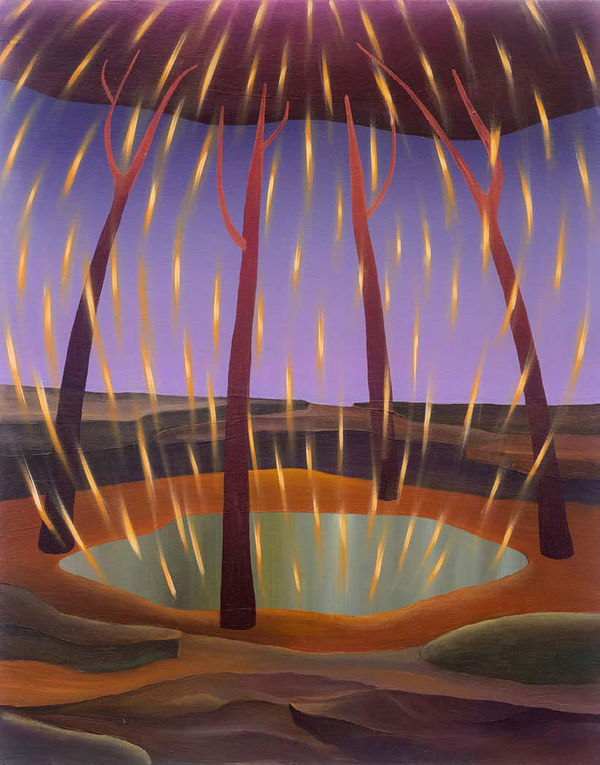
Point V – A Flaming GardenIn Rafael Chavez’s pictorial work, light assumes an almost corporeal intensity, complemented by the suggestion of volume. In thematic terms, stars do not signal distance but pulse as points of gravitation in a terrestrial sky. All of this is crossed by meltings, textures, and neon glows in an almost digital visuality, which is striking when we consider the archaeological memory of the caatinga present in some of the works. These presences of the landscape, translated into intensity, affirm a sensitive territory – a garden that scintillates across its own surfaces and succeeds in bringing sky and earth together as one.Walter ArcelaCAPES Research Fellow in PPGAV/UFPE
Member of the Brazilian Association of Art Critics (ABCA) -
-
-